A domestic gas pilot light's energy consumption measured
by Stephen Hewitt | Published
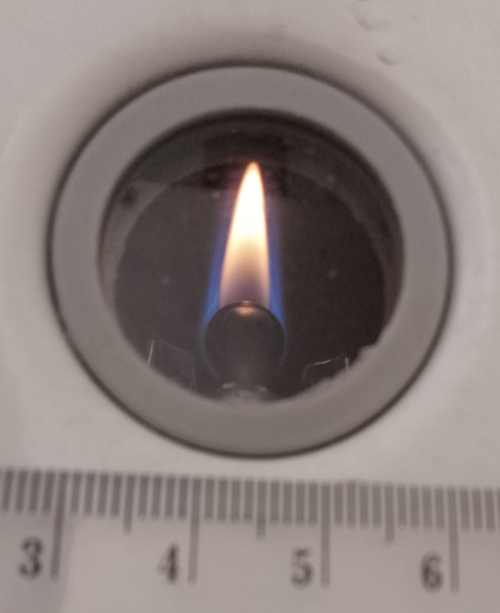
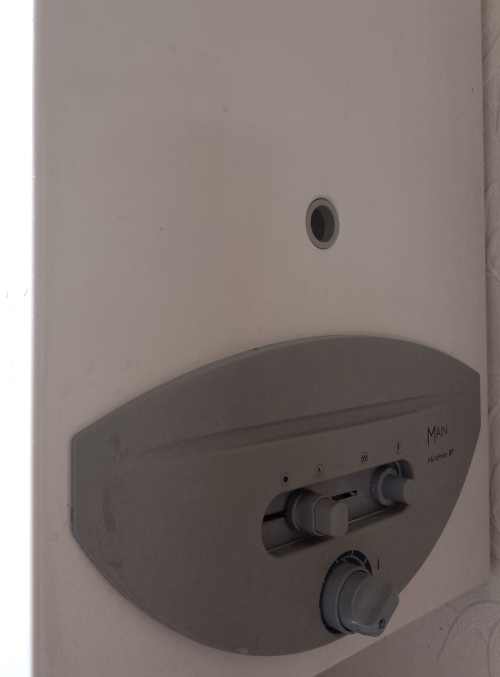
An on-demand domestic gas water heater uses a continuous 130 Watts for its pilot light while it is idle, according to measurements I made with the gas supplier's meter used for billing.
This power represents around 22kWh/week and at 2025 prices in Britain (~6p/kWh) would cost around £1.32/week.
The water heater is a Main (the manufacturer) “Multipoint BF” (balanced flue), shown in Figure 2. Its pilot light is shown in Figure 1. According to the website of one retailer in 2025, this water heater was discontinued in 2018 [1].
How the power consumption was measured
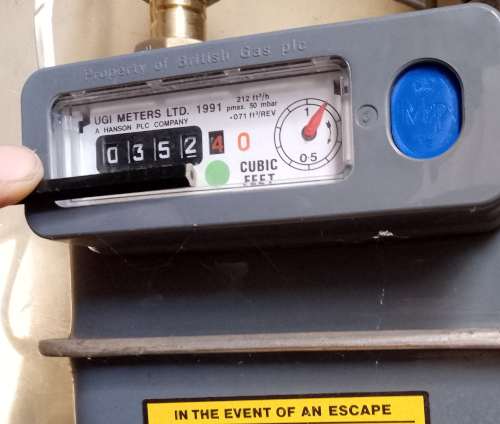
The figure above was measured on the supply meter shown in Figure 3.
First I made an experimental control by turning off the pilot light and all other gas appliances for over a week and confirming that the meter did not move at all during this time.
Then I turned only the pilot light on and left it and nothing else on for several days and monitored the consumption using the meter. Then I converted the volume used as shown by the meter into kWh as specified by the supplier (see below).
Measuring the volume of gas used was slightly complicated by the coarseness of the measurements on the digits of the meter. Whereas the red digit increments in multiples of 10 cubic feet, the red needle rotates once for every cubic foot and so can show fractions of a single cubic foot. But there is nothing in between to indicate single cubic feet.
You could get an accurate measurement of gas used by leaving the pilot light on for multiple weeks and measuring consumption only to the nearest 10 cubic feet using the figures on the digits, including the red one, or you could try to use the rotating needle to measure gas used with greater resolution and so need only a shorter period of measurement.
The difficulty with the second approach is that if you leave too long between observations of the meter, you will not know how many revolutions the red needle has made in your absence because this information is not visible. The red digit will advance only every ten revolutions of the needle. I therefore monitored the needle almost constantly for an hour or two at first so that it did not complete a revolution without me knowing. I discovered that it was moving at a rate very close to one revolution every 2.5 hours. Once I knew this approximate rate, I could leave the meter for hours between observations because I could easily calculate to the nearest integer how many revolutions it must have made in my absence and the fractional part of its advance was visible on the dial, so the combination of these two pieces of information meant I then knew exactly how far it had advanced.
The consumption was calculated over a period of about 34 hours (2,056 minutes) during which time the needle advanced by 13.94 turns. I had multiple intermediate readings during this period and I checked that if the needle were advancing at the average rate I calculated, that the fractional position of the needle at each of these intermediate observations would be close to the observed position, which it was.
A 2025 bill from the gas supplier contained the following explanation.
We convert your metered gas units to kWh using the following formula:
Metered volume x metric conversion factor1 x daily calorific value2 x 1.02264 (volume correction) / 3.6 = kilowatt hours (kWh) used.
1 We convert the gas use into kWh according to your meter type - 2.83 (imperial) or 1 (metric).
2 The calorific value of gas changes every day and can range from 37.5 to 43.0. To find out calorific values used to calculate your charges you can visit: data.nationalgas.com/find-gas-data
The figures that the suppliers ask for if you read the meter would be the white ones in Figure 3, ignoring the red one. This means that the unexplained so-called “metered gas unit” on the bill is in fact 100 cubic feet on an imperial gas meter like the one used here. This is consistent with the metric unit in the formula being a cubic metre, since there are indeed 2.83 cubic metres in 100 cubic feet. (This can be calculated given that there are 2.54cm in an inch and 12 inches in a foot and that a litre is 10cm x 10cm x 10cm)
Incidentally, this means that the granularity of the measurement used to charge for gas is coarse compared to the measurement used for electricity, as according to the formula one so-called “unit” represents approximately 32kWh. In comparison one unit on an electric meter is 1kWh.
In this case I used a calorific value of 40.0 in the formula because that was near the middle of the range stated by the supplier. I divided the cubic feet I had measured from the meter by 100 to get the so-called “units” for the supplier's formula as stated above.
References
- [1]
-
In September 2025 the page at https://www.flexiheatuk.com/main-multipoint-bf-water-heater-new-replacement/ said “If you are looking for a main multipoint BF water heater (main balanced flue water heater), then the bad news is that these gas fired water heaters are no longer available, whether it was the standard model, which was obsolete in 2018, or the ERP model, which was discontinued in 2019.”