In May 1984 I was asked to undertake an investigation in Northern Ireland that very soon pointed towards possible offences of murder and conspiracy to pervert the course of justice, these offences committed by members of the proud Royal Ulster Constabulary. I devoted two years of my life to this task, and I failed. In May 1986, three days before I was due to complete the last and very important part of my investigation, I was removed from it and from my duties as Deputy Chief Constable of the Greater Manchester Police. Ten weeks later I resumed my job in Greater Manchester, but I was not allowed to return to Northern Ireland. A few months later I resigned from the police.
A book about an investigation into police shooting unarmed victims dead in 1980s Northern Ireland
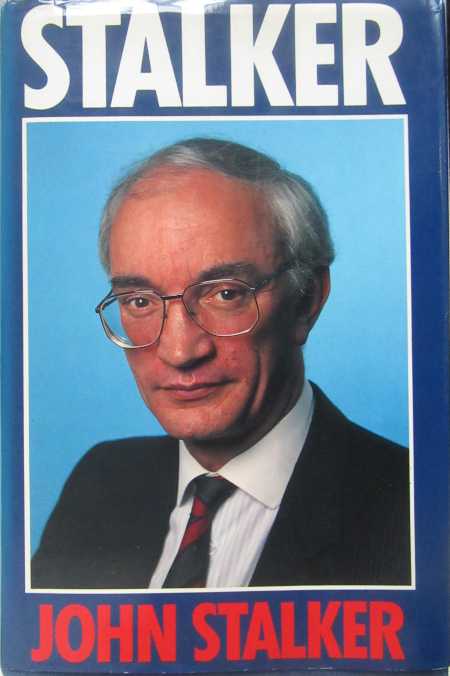
The following extracts are from a hardback book Stalker, John Stalker, Harrap Ltd, 1988 ISBN 0 245-54616-2, which also says “Reprinted 1988 (five times)”. In 1984 the author John Stalker was Deputy Chief Constable of Greater Manchester Police.
page 9:
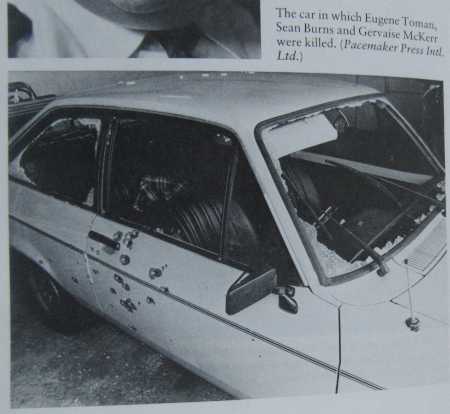
“The car in which Eugene Toman, Sean Burns and Gervaise McKerr were killed. (Pacemaker Press Intl. Ltd)” reads the caption in the 1988 book Stalker.
John Stalker wrote: “No serious attempt to attract the attention of the driver was ever made, and no policeman was struck by the car. The three officers in the police car were waiting, and they fired 108 bullets from a Sterling sub-machine gun, Ruger rifles and a handgun during a pursuit that extended over 500 yards. All the men died instantly; none was armed. I was astonished to learn that all the policemen involved had been instructed to leave the scene immediately, with their car and their weapons and return to their base for a de-briefing by senior Special Branch officers.” (page 41)
page 12-13:
The three principal cases covered by my investigation were as follows. On 11 November 1982 three men were shot dead by members of a special Royal Ulster Constabulary anti-terrorist unit in Tullygally East Road, just outside Lurgan. The men were Eugene Toman, Sean Burns and Gervaise McKerr. They were all unarmed.
Less than two weeks later, on 24 November 1982, two youths were shot, one being killed and the other seriously wounded, by members of the same anti-terrorist unit, in a hayshed in Ballyneery Road North, also just outside Lurgan. The dead youth was Michael Justin Tighe, who was 17 years old, and his companion was Martin McCauley, who was 19. Three old pre-war rifles were recovered from the hayshed, but no ammunition was found.
Less than three weeks after that, on 12 December 1982, two more men were shot dead, yet again by a member of the same special unit, this time in Mullacreavie Park, in Armagh City. They were Seamus Grew and Roddy Carroll. Neither of them was armed.
All these shootings were investigated by other members of the Royal Ulster Constabulary, and files were sent to the Director of Public Prosecutions for Northern Ireland, Sir Barry Shaw. The first prosecution to come before the courts related to the last of the three incidents, and was that of Constable John Robinson. He appeared before Mr Justice McDermott on 3 April 1984, and was acquitted of the murder of Seamus Grew. Neither he nor any other police officer has ever been charged with the murder of Roddy Carroll, who was in the same car as Grew when they were shot. During the trial Constable Robinson gave evidence in his own defence, and it emerged publicly for the first time that the two men had been shot not, as claimed, at a random police road check, but following a long surveillance operation that had taken RUC officers into the Republic of Ireland and back again. Robinson, it was disclosed, was not an ordinary policeman as had been said, but a member of a highly trained special police squad, and the deaths of Grew and Carroll had come at the end of a planned operation involving that special squad. During the trial Constable Robinson told a story that made international headlines: he told the court that he had been instructed by senior police officers to tell lies in his official operation. It became clear that investigating CID officers, the Director of Public Prosecutions, and finally the courts themselves, had all been quite deliberately misled in order to protect police procedures and systems. The revelations created a public outcry. Even as I write, almost five years after the deaths of those men, the story still twists and turns. In this book I try to make some sense of it all.
page 91 - 92:
On 26 June I wrote what as to be my last letter to Sir John Hermon. I placed on record the serious implications of my enquiry as I now saw them. In order to protect the position of myself and the Greater Manchester Police I wished that a letter be put on his file stating that after the most careful re-investigation I believed I could present a great deal of extra evidence, including independent forensic findings, that would indicate that the five men shot dead in their cars were unlawfully killed by members of the Royal Ulster Constabulary. I believed I could safely say that the evidence available to put before the adjourned Coroner's Hearings was substantially more than that presented by the RUC at the criminal trials, and would attract much public interest when the inquests were eventually reopened. I also said that Michael Justin Tighe might also have been unlawfully killed, but I would reserve my final recommendation on that until I had received the tape of the shooting - if it existed.
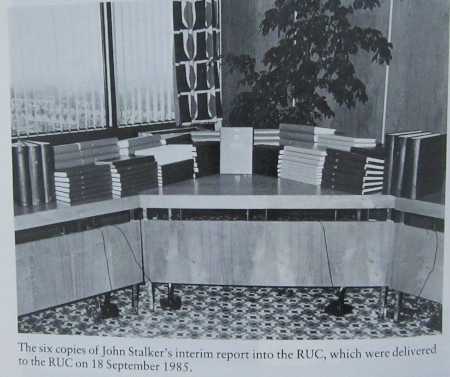
“The six copes of John Stalker's interim report into the RUC, which were delivered to the RUC on 18 September 1985.” reads the caption in the 1988 book Stalker
John Stalker wrote: “Each complete set of case papers ran to sixteen thick volumes, and I prepared six complete sets. I had the documents commercially bound at a Manchester printers under very close and constant police supervision. The normal type of in-house police binding is by a plastic spiral spine, but I was anxious that nothing be removed from these files until the Director of Public Prosecutions had seen his copy.” (page 93 - 94)
page 93:
We had interviewed, at great length, about three hundred police officers - some of them under-cover and secret-surveillance men and women who had witnessed possible criminal acts and had not been previously interviewed. We had taken about six hundred written statements from policemen, forensic scientists, doctors, pathologists, members of the public and relatives of the dead men. Each shooting was written up, documented, prepared and arranged as a separate prosecution file but with a ‘link report’ showing the connections between the shootings and the Kinnego murders of the three policemen.
page 220:
I went into work on Tuesday 21 October, to find letters and telephone calls for me pledging financial help. they were from people I did not know, not all of them local, and one of them was for the substantial amount of a thousand pounds. I was at a complete loss to know what to do; the situation was wholly unprecedented. I had not asked anyone for anything and yet already cheques and postal orders were arriving from members of the public.
The same day a police constable telephoned the Chief Constable's secretary and then sent in a letter asking for permission to arrange a collection from the members of the Force to assist me. He said that there was a great deal of support from ordinary policemen on the streets and many of them had expressed a wish to contribute. I discussed these developments with Mr Anderton. They were wonderfully kind and positive gestures, but I could not do anything about them without the Chief Constable's authority.
page 224 - 225:
The public were now free to donate, but many weeks had gone by and the fund was effectively moribund. It stood at about £3,000, almost £19,000 short of the original bill, and donations had stopped. Then the Observer newspaper mentioned the matter, very briefly, and the result was unbelievable. Hundreds, and then thousands of donations came either to me or to the Manchester Evening News. I cannot describe the tears I shed inside for the generosity shown by those thousands of people. It was, frankly, one of the most humbling experience of my whole life to read these letters and cards from people I will never meet, many of them anonymous, enclosing in some cases a postal order or a coin taped inside a Christmas card. The thread that ran through them all was one of sorrow and anger at the manner in which things had been handled, and of sympathy for my wife and parents. This swell of support from ordinary folk - most of them, I am certain, much worse off than me, was simply the most remarkable act of faith I have ever witnessed.
page 254:
In September 1985 I submitted to the Chief Constable of the RUC a first report that recommended the prosecution of eleven of his police officers, ranging in rank from constable to Chief Superintendent, for a variety of criminal offences, including conspiracy to pervert the course of justice and perjury. In that report I also asked for access to a secret MI5 tape recording that I believe would have supported further charges against other police officers of perjury and possibly murder and attempted murder. The Chief Constable kept this report for for five months before passing it, in February 1986, to the Director of Public Prosecutions, who within a few days gave me the authority I sought to listen to the tape and to carry on with my investigation. I had made no secret of the fact that those enquiries would involve the formal interview of a number of very senior police officers (including the Chief Constable) about the parts they had played in events during and after the shootings. It was well known to Home Office and other government officials, including MI5 officers, that my renewed enquires would, by law, have involved discussions with the Northern Ireland Police Authority if at any stage I suspected disciplinary offences on the part of those senior officers.
Three days before I was to return to Northern Ireland to recommence my work, on 28 May 1986, I was forever removed from the investigation, and as I write this, well over two years after the day upon which I first delivered my report to Sir John Hermon recommending prosecutions, there has still been no announcement either supporting or rejecting those recommendations. There has been only silence.
Acronyms
- RUC
- Royal Ulster Constabulary