A low-tech countermeasure to high-tech bugging?
by Stephen Hewitt | Published

This article presents an untested idea for countering audio eavesdropping of a conversation between two people. The idea is to use a flexible plastic pipe such as the one in the first photograph as a speaking tube that leads directly from the speaker's mouth to the listener's ear. The listener holds the end of the tube against an ear and the speaker whispers or talks very quietly down the tube. To both speak and listen they either use two tubes, or each moves the end of the tube between ear and mouth.
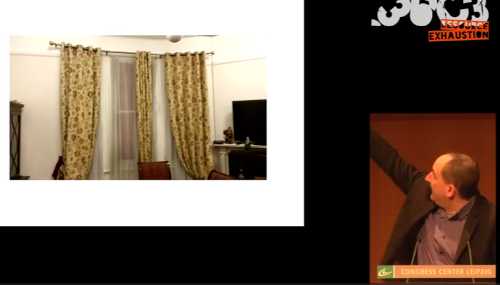
A 2019 public talk [1] provides some reasons for optimism about the effectiveness of this idea even in the case of a victim as important as Julian Assange and his lawyers. But there are also some reasons for caution.
The talk, titled “Technical aspects of the surveillance in and around the Ecuadorian embassy in London” included photographs from inside the embassy and emails of the attackers.
Reasons for optimism are that a simple white noise generator with a loudspeaker used by Julian Assange seems to have given the attackers significant difficulties in obtaining audio with microphones. And you would speculate that if the white noise generator alone was a significant countermeasure then a white noise generator plus voices made so quiet by the tube that they are inaudible in the room would be even more effective. And the speaking tube might allow the noise generator to be turned up louder, without becoming a problem to the legitimate parties.
Reasons for caution are that in this kind of situation things might not be how they seem and the existence of scientific publications such as the review paper [2] shows that remote bugging using radar, possibly directly on the larynx or vocal cords, may be a viable technique. In this case the plastic tube might not help or might itself even provide a vibrating surface amenable to radar sensing.
Near the start of the talk Andy Müller-Maguhn said ... “This presentation does cover some but not all aspects of the surveillance”... “there was more things going on, there was an on-going heat in the embassy which made us think they might be using nanometre waves to look through the walls and from the ceilings above and below and so on. However we are still getting documentation about other things, so this is like the state of affairs right now.”
References
- [1]
-
Technical aspects of the surveillance in and around the Ecuadorian embassy in London during the stay of Julian Assange, a talk given by Andy Müller-Maguhn on 30 December 2019 at the 36th Chaos Computer Congress, Leipzig.
In March 2026 a video of the talk as an MP4 file with SHA256 hash 3738cd7e289eb9473800aa7b4ca0bd8f31e853fc8c8bb6d54bda4ca125726bf9 was linked from page https://media.ccc.de/v/36c3-11247-technical_aspects_of_the_surveillance_in_and_around_the_ecuadorian_embassy_in_london . The page also contained links to other video files in various formats.
- [2]
-
Recovering Speech from Vibrations: Principles and Algorithms in Radar and Laser Sensing, Emily Bederov, Baruch Berdugo and Israel Cohen, 2026
In April 2026 PDF file with SHA256 hash 8d0e829611bdaaf3d4b243efabe1af0a459c7eef4b0b4f4c27dccb70191e8cbb was linked from page https://www.mdpi.com/1424-8220/26/8/2553 .