Measured efficiency of a gas hob heating water
by Stephen Hewitt | Published | Last updated
This article reports empirical measurements of the efficiency of a gas hob heating water to a temperature below boiling point.
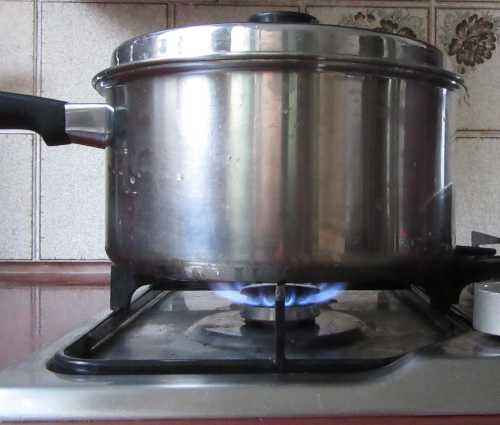
The measurements were made using the saucepan and gas burner in Figure 1. The saucepan was made of thin stainless steel, with a single thickness for its base and with outside diameter 21 cm. The gas ring was the smallest one on this cooker, 5cm across the diameter of its top steel disc, shown in Figure 3.
The amount of water to heat, 363g, was the amount to fill a particular tea mug as the intent was to measure likely efficiency of heating water for a cup of tea.
Method
A known amount of water (363g) was heated for 200 seconds and its temperature change was measured. The gas consumption was measured with the supplier's meter used for billing (Figure 2). The efficiency was taken as the theoretical amount of energy required to raise the water temperature divided by the supplier's stated energy value for the gas used.
This heating was performed a total of eight times. Between each of these heatings, the removable parts of the gas burner shown in Figure 3 were cooled by dropping them into water at room temperature and leaving them for a few minutes. Excess water was then shaken off, but this method means these burner parts were wet at the start of each heating. The loss of heat in vaporising this water is assumed to be negligible.
Between heatings the saucepan was also cooled back down to room temperature by swilling it with water. In addition the new water to be heated was swilled around the saucepan and allowed a minute or so to reach equilibrium before its starting temperature was measured.
Each sample was heated for 200 seconds. At the end of heating period the gas was turned off and the water was poured as quickly as possible into a pre-heated double walled 500mL food flask and sealed. The flask was then shaken and inverted a few times and then re-opened and the water temperature immediately measured with a bare K type thermocouple.
The total gas consumption over the eight heatings was read from the meter. Prior experience had shown that this meter does not have fine enough resolution for accuracy with the smaller quantity of gas used in a single heating.
After a first dummy run, whose results were not recorded, the pre-heating of the flask with hot water was achieved by simply leaving the previous sample in the flask until a few seconds before the next one was ready to go into it. The flask was then shaken and inverted a few times before opening it to discharge to old water and receive the new sample. On most tests I checked the temperature of the residual water just before pouring it out to make way for the new water.
Results
The temperature measurements for each of the eight heatings are shown in Table 1.
| Initial | Final |
|---|---|
| 20.0 °C | 77.0 °C |
| 20.7 °C | 76.6 °C |
| 21.0 °C | 78.1 °C |
| 20.8 °C | 77.2 °C |
| 20.7 °C | 77.8 °C |
| 20.6 °C | 77.4 °C |
| 20.5 °C | 77.1 °C |
| 20.7 °C | 77.6 °C |
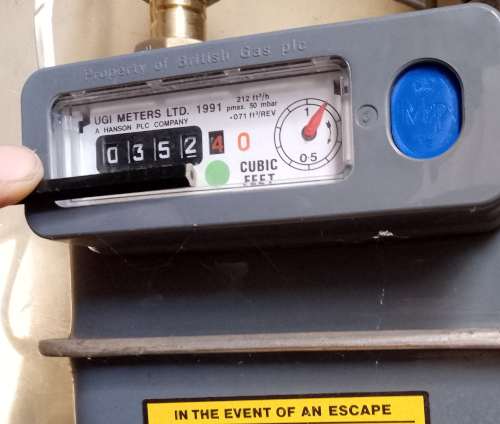
During the course of these eight heatings, the red needle on the gas meter had moved a total of 1.4 revolutions, meaning 1.4 cubic feet had been used.
The pre-heating water in the flask was always about 74 °C when it was measured.
Calculations
Adding the temperature changes in Table 1 gives a result of 453.8 °C or Kelvin. Knowing that all these temperature increases were for 0.363kg of water and using 4.18 kJ/(kgK) as the specific heat of water, we get the following for the heat energy that has been put into the water
Heat in kJ = 4.18 x 0.363 x 453.8, which is about 688.6 kJ
To find the amount of energy supplied in the gas, we note that a 2026 bill from the gas supplier contained the following explanation.
We convert your metered gas units to kWh using the following formula:
Metered volume x metric conversion factor1 x daily calorific value2 x 1.02264 (volume correction) / 3.6 = kilowatt hours (kWh) used.
1 We convert the gas use into kWh according to your meter type - 2.83 (imperial) or 1 (metric).
2 The calorific value of gas changes every day and can range from 37.5 to 43.0. To find out calorific values used to calculate your charges you can visit: data.nationalgas.com/find-gas-data
The cubic foot, measured by one revolution of the red needle in Figure 2, is one hundredth of the “unit” by which the company charges. So applying its formula to the 1.4 cubic feet used in this experiment we get:
kWh in supplied gas = 1.4/100 x 2.83 x 40 x 1.02264/3.6
Or, kJ in supplied gas = 1.4/100 x 2.83 x 40 x 1.02264 x 1000, which is about 1620 kJ
The efficiency at converting energy in the gas to heat in the water is therefore around 688.6/1620 or 42.5%
Quantifying one route of heat wastage
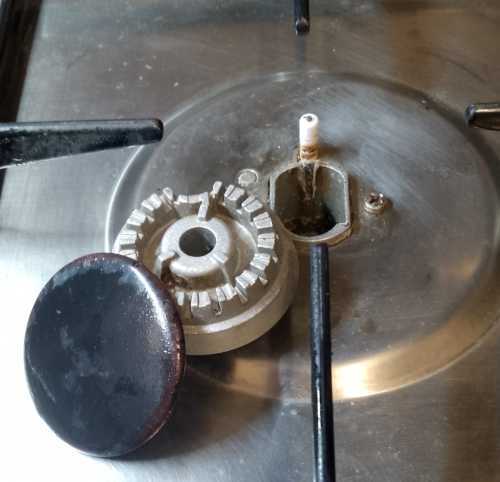
In this design of gas burner you can simply lift off the steel disc on the top and then the casting underneath. Figure 3 shows the gas burner with the steel disc and the die-cast jets separated.
After using the hob for a few minutes, they are both very hot and a spot of water dropped onto them is vaporised instantly. I measured the heat in them by dropping them into 363g of water immediately after using the hob and measuring the increase in water temperature once they reached thermal equilibrium with it. This was the same amount of water as used in the experiments already described, making it easy to compare the heat energy.
Table 2 shows the results of doing this after heating water in the saucepan using the burner, in the same way as in the earlier experiments already described.
| Period | Initial | Final |
|---|---|---|
| 90s | 20.3 °C | 23.1 °C |
| 200s | 20.9 °C | 26.7 °C |
| 240s | 20.3 °C | 26.5 °C |
For the period of 200s as used in the experiments, we see that the temperature of 363g of water was raised by 5.8 °C. Now in the experiments the temperature of 363g of water in the saucepan was raised on average by around 56.7 °C. This means the heat wasted in these components is slightly more than 10% of the heat that went into the water we wanted to heat.
Discussion
You might think that rather than performing N separate heatings to overcome the lack of fine resolution of the gas meter it would have been possible simply to calculate the gas used based on time. You could run the burner for half an hour (say) and measure the gas used. Then, you might think, you could calculate the gas used in 200 seconds as a fraction of half an hour. Unfortunately, this does not give the correct result, because the self-heating of the burner means that it does not use a constant amount of gas. Prior experiments watching the meter had shown that the cold burner consumes gas at a higher rate than the hot burner. And the change is over a period of the order of minutes, as Table 2 shows.
The reduction in flow rate is predicted by theory. The hot burner transfers heat to the gas flowing through it. As the burner gets hotter, the gas emerging through its jets will be hotter. The hotter gas is less dense but, because it still has the same mains pressure behind it, the volume flow rate through the jets remains the same, while the mass flow rate is reduced.
At constant pressure, the density of an ideal gas will be proportional to its absolute temperature, so we can get a feel for the potential magnitude of this change in density by calculating a rough figure for the temperature of the burner, based on the heat extracted from its parts shown in Table 2.
The specific heat of steel is 0.49 kJ/(kgK) and the specific heat of zinc alloys is about 0.42kJ/(KgK). The steel disc in the burner weighed 41g and the alloy weighed 36g, so, making the approximation that both these parts are heated to the same uniform temperature, we can say that their combined heat capacity is therefore
0.49 x 0.041 + 0.42 * 0.036 kJ/K or about 0.035 kJ/K
The last two lines of Table 2 show that after running the burner for 240 seconds it did not hold much more heat than it did after running it for 200 seconds, so this is presumably approaching equilibrium.
Anyway, taking the figure for 240 seconds of heating from Table 2 we have a 6.2K temperature increase in 363g of water from the heat released on immersing the hot burner parts. Taking the specific heat of water as 4.18 kJ/(kgK), this heat energy is
4.18 x 0.363 x 6.2 or about 9.41 kJ
so the corresponding temperature increase in the burner parts is
9.41/0.035 or about 269 K
This represents the heat released in cooling them to 26.5 °C, which means that their temperature in use on the burner would have been 26.5 + 269 = 295.5 °C.
This is likely an underestimate because I had to quickly transfer them, one at a time, from the cooker to the water using a pair of pliers and heat would have been lost during this process. There was also a short audible hiss as I dropped each of them into the water, which also represents heat loss.
However this temperature increase from about 293 K to 273 + 295 = 568 K represents almost a doubling of the absolute temperature of the burner. If the change in gas temperature matched this, the gas density would nearly halve, and it would represent nearly a 50% reduction in mass flow rate of the burner on heating up.
The assumption of constant gas consumption for this kind of burner is a potential pitfall for anyone making these kind of measurements. So too is failing to take into account the initial burner temperature.