The ring-necked parakeet, a new-comer established in Birmingham by 2025
by Stephen Hewitt | Published
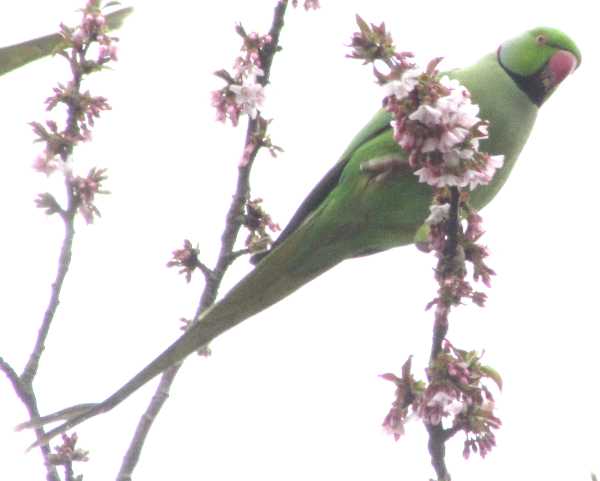
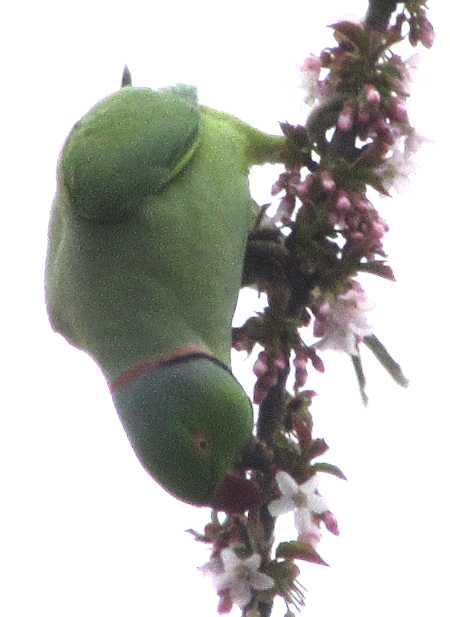
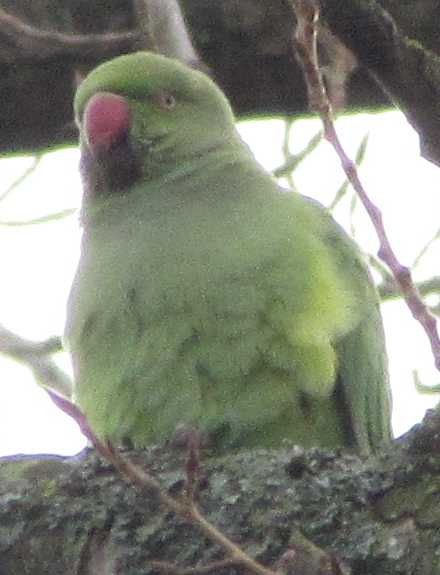
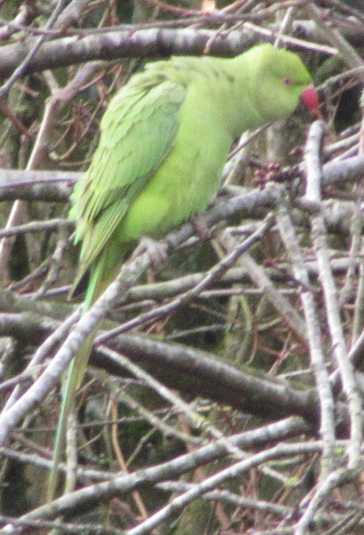
The photographs here show ring-necked parakeets (Psittacula krameri) in in the suburbs of Birmingham, England in 2026. This bird is a new arrival unknown in Birmingham last century. In fact I had never seen a wild parakeet anywhere in Britain until I found them in Birmingham in 2025.
This bird is bright green with a red beak, and a long tail, which sometimes appears to be forked. It is about the same size as a magpie. Then length of the tail helps a lot with identification from a distance or even in silhouette.
It seems to be relatively fearless, not afraid to draw attention to itself. Its call is a loud monosyllabic shriek, sometimes a single one, but often then repeated in a burst of three or four. It makes itself conspicuous by this, which it gratuitously emits as it flies over (on no discernible stimulus). And it shrieks alone and in a flock. If you hear this and look up, you can identify the flock even from a distance by the long tails. (This bird might also make different, softer noises when it is not flying. I have heard noises from a tree with a parakeet in it, but but I have not been able to observe closely enough to be sure the source was the parakeet.)
It also doesn't care if you stand under its tree and look up and photograph it, whereas, for example, a wood pigeon will take off when I raise a camera from 100 yards away.
It is evidently a social bird, often seen in a flock. In 2025 I watched what seemed like a feeding raid of 20 or more birds moving from tree to tree in suburban gardens.
In Birmingham, Ray Dedicoat runs a charity “Hollytrees Animal Rescue Trust”, sending out a newsletter at the end of every year. At the end of 2025, with decades of experience of rescuing animals and birds, he wrote in issue number 63:
“Another strange one we're getting more and more calls about are parrots and parakeets. Birmingham seems to be full of them these days, with wild colonies popping up all over the place, including a large one around Handsworth Wood!”